
Part II: Refugees from World War II escape enemy capture, bombs and death to find each other at... a dance
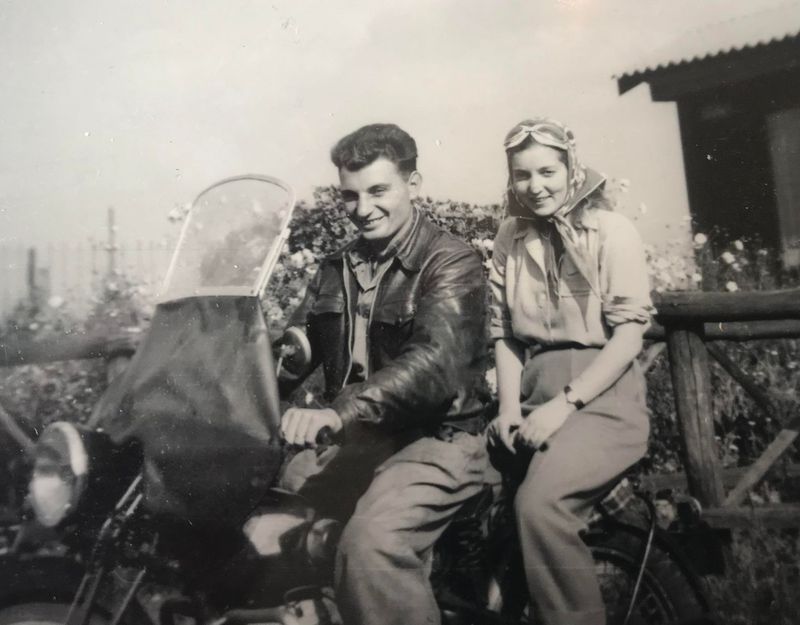
Martin Schmidt and Jacqueline Virginie Guillaume, shown in 1950 in France before they married and immigrated to Canada, then the U.S. as Marty and Jackie Smith. (Jackie Smith)
Today’s column is the second in a series on Martin Schmidt and Jacqueline Virginie Guillaume, World War II teenage refugees from Europe who married in 1951 and later emigrated to this area as Marty and Jackie Smith.
After losing his identification papers during a historic bombing attack by Allied forces on the city of Kassel, Germany, 17-year-old Martin Schmidt had only his birth name and the mastery of three languages. English and French were not yet one of them.
At 15, young “Martzy” had to flee his Transylvania home as Nazi Germany troops marched across Europe in the early 1940s. Adolph Hitler’s evil plan for world domination was launched near Martzy’s homeland of Romania. His father was drafted by the Nazis and soon imprisoned by the Russians. His mother died when he was 4.
Martzy wandered alone in hostile countries with nothing but teenage courage, a charming disposition and the will to survive World War II. He didn’t yet know that just over the French border, the future love of his life also was struggling to survive while assisting the French underground. Their fate together would have to wait.
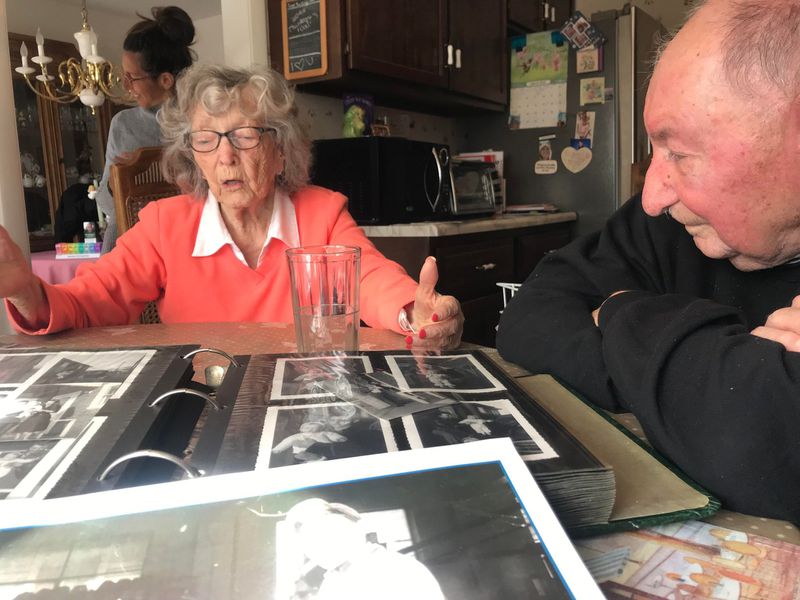
Jackie Smith, 95, and Marty Smith, 94, look through old photos of their life together in Europe before immigrating to Canada, then the U.S. after marrying in France. (Jackie Smith)
“What can I do for you?” a U.S. Army sergeant asked Martzy near a camp for displaced persons.
“I’m looking for a job,” he replied.
“What can you do?” the officer asked.
“I’m a mechanic,” Martzy replied in broken English.
“Mechanic?!” the officer asked. “Stay right here. Don’t move.”
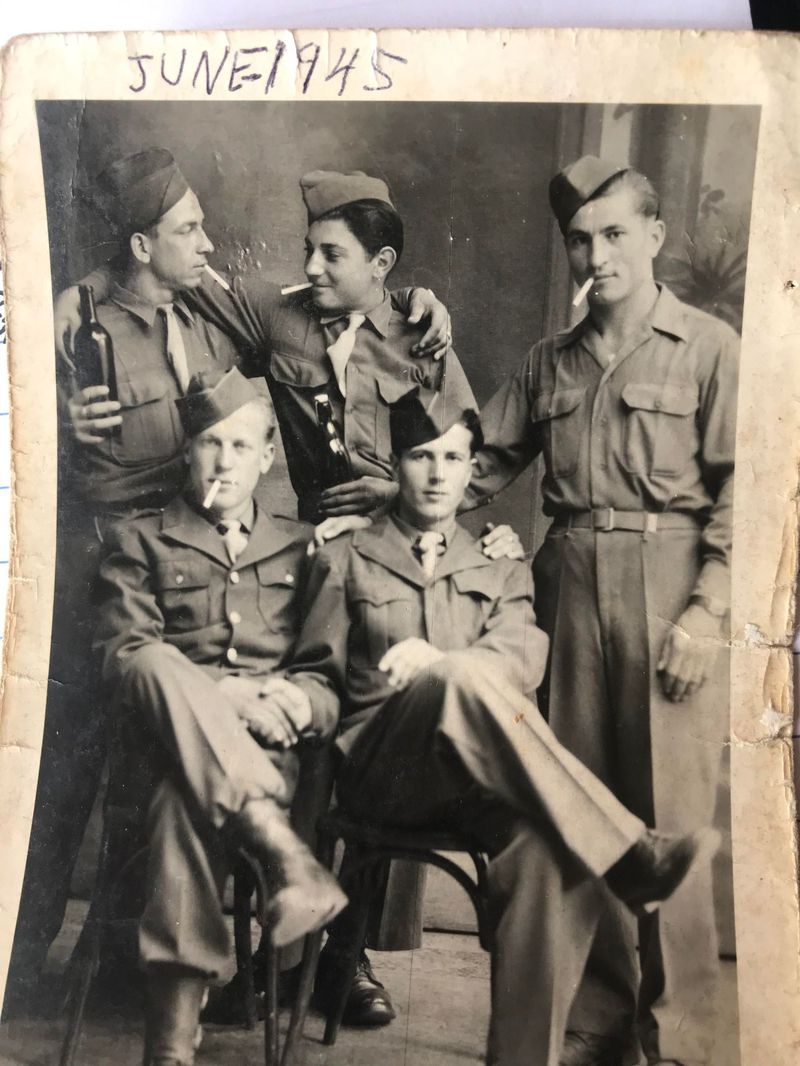
Martin Schmidt, as he was then known, shown in a photo from June 1945, with other soldiers in the U.S. military. He is in the center, top row, looking to his right. (Marty Smith)
Martzy was instructed to return the next morning to start his new job, repairing Allied military vehicles that were sabotaged by Nazi troops before they retreated. He eventually figured out how the Nazis sabotaged the engines. He repaired them one by one, he said.
U.S. Army officials took notice and embraced the Transylvanian refugee, inviting him to live in the camp’s barracks, where Martzy also cooked for soldiers. “That’s when I learned how to play poker with cigarettes,” recalled Marty Smith, now 94, who changed his name when he left Europe in 1951.
At 19, he worked for the U.S. military in many capacities. This included raising American flags each day over three French cemeteries filled with thousands of soldiers killed in the war, he said. His only companion was a wandering mutt like him, Max.
“He followed me everywhere,” Smith said, staring at an old photo of him and the dog.
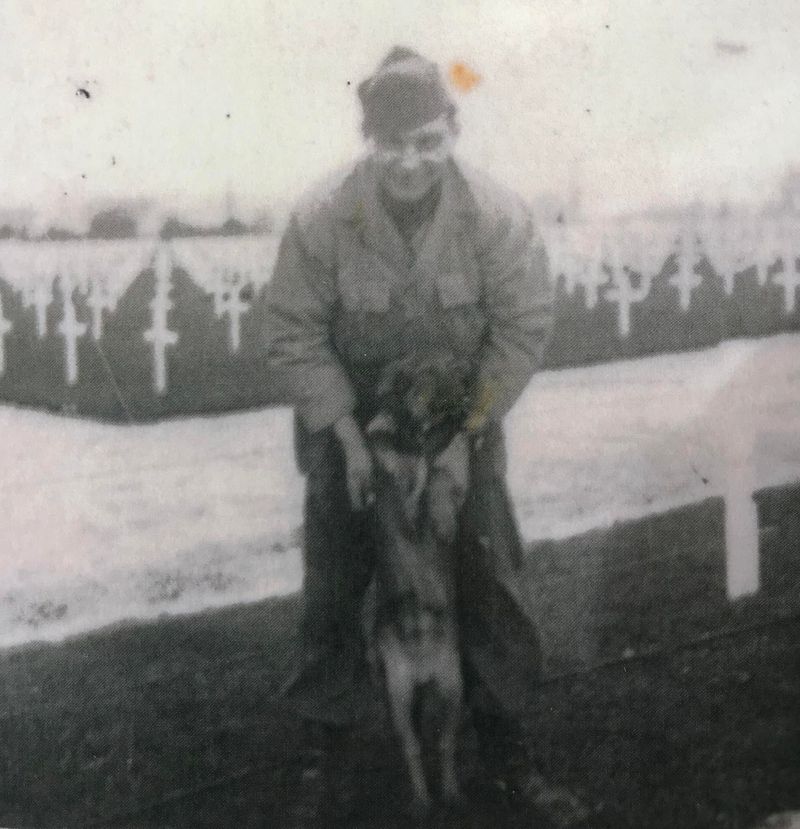
Martin Schmidt worked for the U.S. military in many capacities in France. This included raising American flags each day over three cemeteries filled with thousands of soldiers killed in the war. His only companion was a wandering mutt like him, Max. “He followed me everywhere,” he said. (Marty Smith)
He has dozens of black-and-white photos from his years during the war. One shows the mannish boy peering over the shoulder of a local mayor and a military official as they sign an important document. Another photo captured him in the presence of legendary U.S. Gen. George S. Patton. Another image shows him pointing to a directional sign to Paris. Martzy appears to be the Forrest Gump of his time, popping up in different European countries as history unfolded around him.
In 1947, he watched cemetery officials unearth the bodies of Allied soldiers in body bags to be cremated or properly buried or transported to their hometown. He remembers all the dark shadows of war.
“He had a rough life as a teenager,” said his wife, Jackie Smith, who’s now 95.

During the war, Jacqueline Virginie Guillaume was forced to flee her home in Neuville-sur-Ornain, France, with her mother, her younger siblings, and a wheel barrow to haul their only belongings as Nazi troops occupied their country. As a teenager, she secretly helped the French resistance without her mother’s knowledge.
“I felt fearless,” she said while looking through old photos of herself. “Hate will do that to you. There’s a lot of hate in war.”
A similar mindset can be felt today by Ukrainians after Russian troops invaded their homeland late last month. This land assault may be the largest conventional military attack in Europe since World War II, when young Jackie escaped German bullets from low-flying planes, whistling bombs from air raids, and sexual assaults from soldiers.
“There was a lot of raping during the war,” she recalled.
At one point, her mother arranged for a French resistance soldier to live in their home to protect her daughter from German soldiers. This is how Jackie got involved in the resistance.
“I wanted to do anything I could to help,” she said.
After fleeing their home, she and her mother and younger brothers once ran from Nazi planes spraying random bullets into a field of refugees, she said. Her family ran into a barn for shelter, not realizing its roof was long gone from a bombing. They stood out like fish in a barrel.
“All we could do was laugh,” Jackie said. “In that kind of situation, sometimes laughter is all you have. We laughed a lot. We cried a lot. We were at war.”
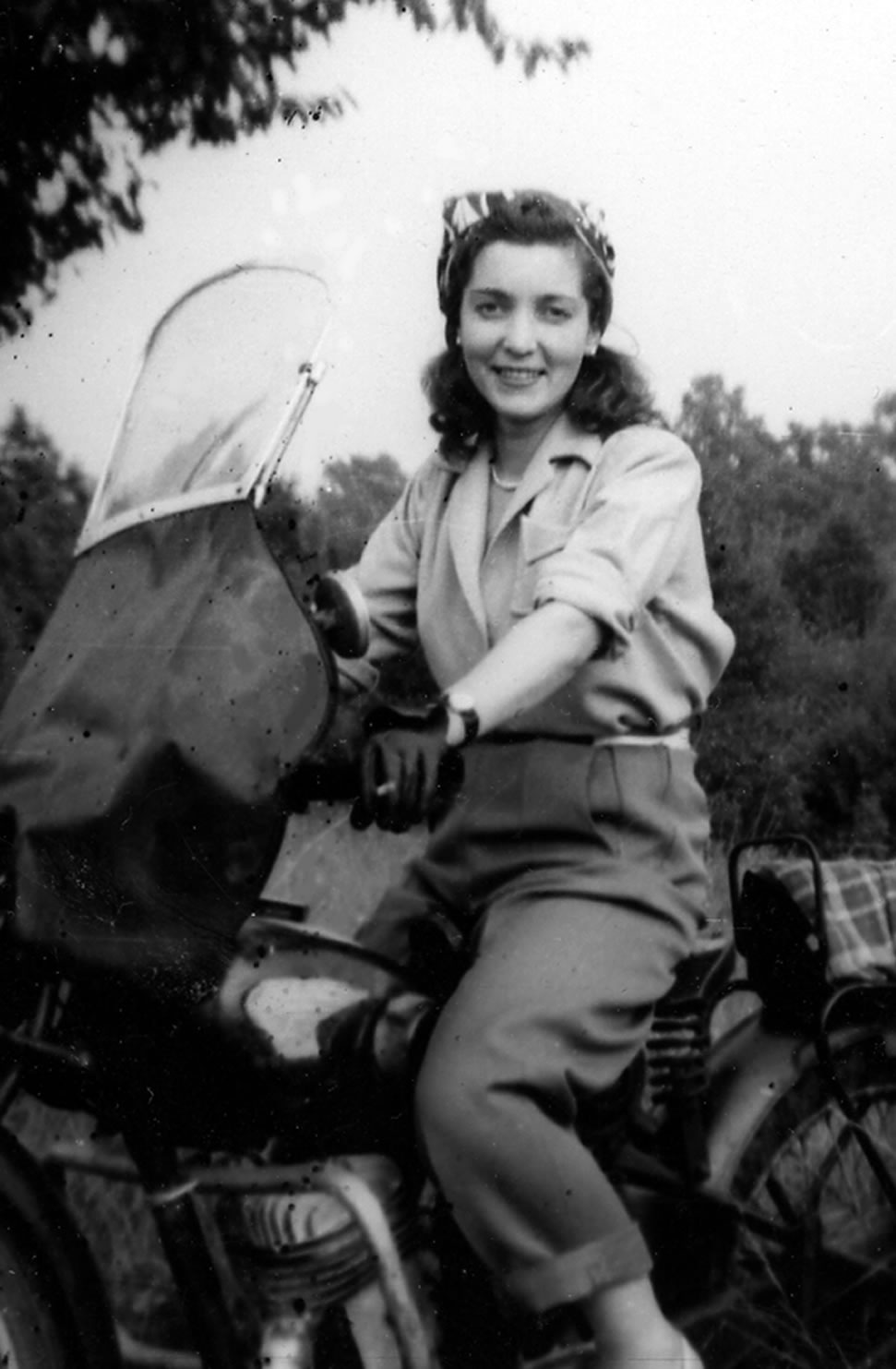
Jackie Smith, shown here in 1950, found a job at a government office after the war. One day, a good looking young man approached her for paperwork for his motorcycle. “She was the most beautiful woman I ever saw in my life,” Marty said. (Jackie Smith)
After the war, she found a job at a government office processing permits and driver’s licenses. One day in 1949, a good looking young man approached her for paperwork for his motorcycle. She didn’t really notice him. He certainly noticed her.
“She was the most beautiful woman I ever saw in my life,” Marty recalled in his native Romanian accent.
“I didn’t want to go on a date with an American soldier,” she recalled in a French accent.
Marty wasn’t an American but he wore a U.S. military uniform. It didn’t deter his overtures for her. At a social dance in Bar-le-Duc, France, he was the first guy to arrive. She saw him and shrugged. He asked her for a dance anyway.
“Well, I loved to dance and he turned out to be a good dancer. So that’s the way I met this guy,” Jackie said, looking at her husband of 70 years from across their kitchen table.
In my next column, I’ll share the rest of their story, how they emigrated here, and their message to the world as another war unfolds near their homelands.
Watch videos in their own words and view more photos on my Facebook page, https://www.facebook.com/JerDavich/. Read my first column of this series on my webpage, www.chicagotribune.com/suburbs/chi-jerry-davich-staff.html.